GST Input Tax Credit Reconciliation: What Businesses Should Check Before Filing
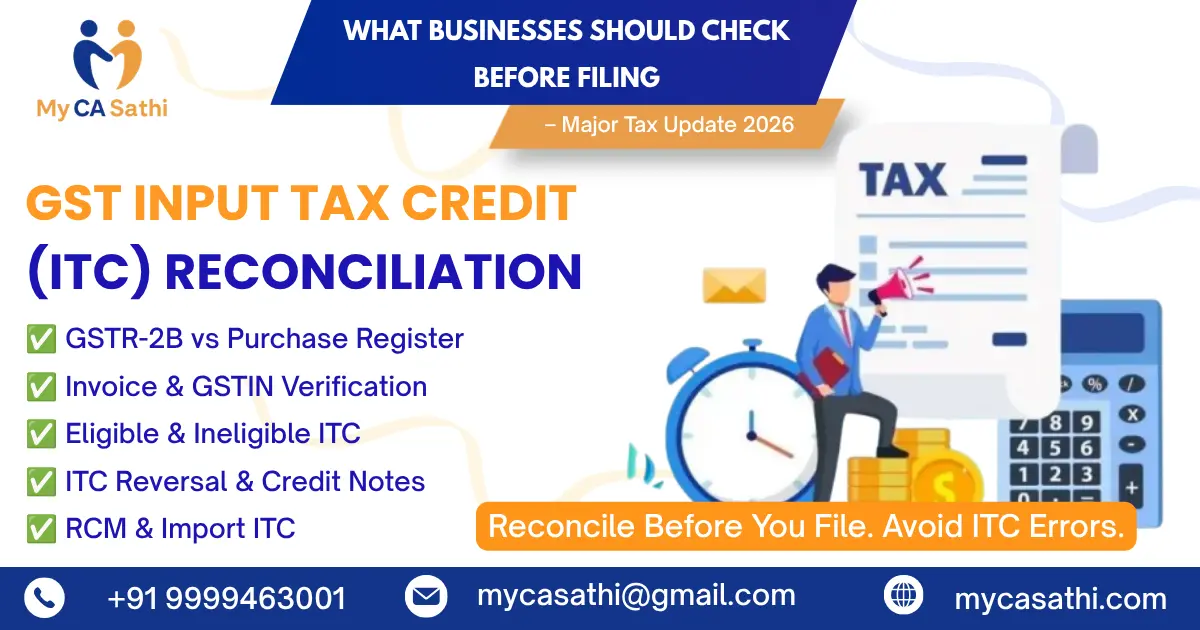
Input Tax Credit (ITC) is one of the most important components of GST compliance. Businesses can reduce their output GST liability by claiming eligible ITC, but the credit should be properly verified and reconciled before it is reported in GSTR-3B.
A simple comparison of the purchase register with GSTR-2B is not always enough. Businesses should also check invoice details, eligibility of credit, credit notes, reversals, reverse charge transactions and other applicable GST conditions.
The GST Portal advises taxpayers to reconcile GSTR-2B with their own records and books of accounts and specifically highlights the need to avoid duplicate ITC claims and make required reversals.
This guide explains what businesses should check before finalising their GST ITC and filing GSTR-3B.
What Is GST Input Tax Credit Reconciliation?
GST ITC reconciliation is the process of comparing the ITC recorded in the business's books and purchase records with the ITC appearing in GSTR-2B and identifying differences before filing the GST return.
A typical reconciliation involves comparing:
Purchase Register ↔ GSTR-2B ↔ GST Invoices ↔ GSTR-3B
The objective is to identify:
- Missing invoices
- Invoices appearing in GSTR-2B but not in books
- Invoices recorded in books but not appearing in GSTR-2B
- Duplicate invoices
- Incorrect GSTIN details
- Credit notes
- ITC reversals
- Ineligible ITC
- Reverse charge transactions
- Import-related ITC
GSTR-2B is an auto-drafted, static ITC statement generated based on information furnished by suppliers and other specified sources. It is intended to assist taxpayers in determining ITC for GSTR-3B.
Why Is ITC Reconciliation Important?
Incorrect ITC reporting can create differences between the taxpayer's books, GSTR-2B and GSTR-3B.
Regular reconciliation can help businesses:
1. Avoid Duplicate ITC
The same invoice should not be used to claim ITC more than once.
The GST Portal specifically advises taxpayers to ensure that credit is not availed twice for any document.
2. Identify Missing ITC
An eligible invoice may be recorded in the purchase register but may not yet appear in GSTR-2B.
Such differences should be investigated rather than automatically claimed.
3. Identify Ineligible ITC
Not every amount appearing in GSTR-2B automatically means that ITC can be claimed.
The GST Portal itself states that taxpayers must self-assess eligibility and reverse credit where required under other legal provisions.
4. Reduce Return Mismatches
Regular reconciliation helps businesses identify differences before filing GSTR-3B instead of discovering them after the return has been filed.
What Businesses Should Check During ITC Reconciliation
1. Match the Purchase Register With GSTR-2B
Start by comparing the purchase register with the corresponding GSTR-2B data.
Check:
- Supplier GSTIN
- Invoice number
- Invoice date
- Taxable value
- CGST
- SGST/UTGST
- IGST
- Invoice type
- Credit/debit notes
Any difference should be investigated before finalising ITC.
2. Check Whether the Invoice Is Actually Received
Businesses should maintain proper supporting documents for ITC claims.
Under the CGST Act, eligibility for ITC is subject to prescribed conditions, including possession of appropriate tax documents and receipt of goods or services.
Therefore, businesses should check whether:
- The invoice is available
- Goods or services have been received
- The invoice relates to the business
- The GST charged is correctly recorded
- Supporting documents are available
3. Check Supplier GSTIN and Invoice Details
Incorrect supplier information can create reconciliation issues.
Verify:
- Supplier GSTIN
- Legal name
- Invoice number
- Invoice date
- Taxable value
- Tax amount
- Place of supply where relevant
If an invoice has incorrect information, contact the supplier for correction wherever required.
4. Identify Invoices in Books but Missing From GSTR-2B
One of the most common reconciliation differences is:
Purchase Register → Invoice recorded
GSTR-2B → Invoice not appearing
This may happen because the supplier has not yet reported the invoice or because the invoice information has been reported incorrectly.
Do not automatically treat every invoice in the purchase register as available ITC.
Instead, identify the reason for the mismatch and track it for subsequent reconciliation.
5. Identify Invoices in GSTR-2B but Missing From Books
The reverse situation can also occur:
GSTR-2B → Invoice appearing
Purchase Register → Invoice missing
Businesses should investigate these invoices before including them in ITC.
Possible reasons may include:
- Purchase entry not recorded
- Invoice received late
- Duplicate supplier reporting
- Incorrect GSTIN used by supplier
- Accounting omission
The accounting records should be updated only after verifying the underlying transaction.
6. Check ITC Not Available in GSTR-2B
GSTR-2B contains information regarding ITC that is marked as not available in specified situations.
The GST Portal states that certain credit shown as "ITC Not Available" should not be entered in Table 4(A) of GSTR-3B. It also cautions that there can be other situations under GST law where ITC may not be available and taxpayers need to self-assess those cases.
Therefore, businesses should review the relevant GSTR-2B sections instead of considering the entire statement as automatically claimable ITC.
7. Check Credit Notes and Debit Notes
Credit notes can reduce the amount of ITC available, while debit notes can affect the amount of ITC associated with a transaction.
Businesses should reconcile:
- Original invoice
- Credit note
- Debit note
- Amendments
- ITC already claimed
GSTR-2B reflects relevant credit/debit notes and amendments, and the GST Portal provides corresponding auto-population logic for GSTR-3B.
8. Check ITC Reversal
ITC reconciliation should not stop at identifying available credit.
Businesses should also determine whether any credit needs to be reversed.
Review:
- Ineligible ITC
- Credit notes
- Applicable blocked credits
- Other statutory reversals
- Previous-period reversals
- Temporary/reclaimable reversals, where applicable
The GST Portal advises taxpayers to ensure that required credit reversals are made in GSTR-3B.
9. Review Reverse Charge Transactions
Reverse charge transactions require separate attention.
Where tax is payable under RCM, the business should verify:
RCM Liability → Tax Payment → Eligible ITC
The GST Portal's GSTR-2B guidance notes that inward supplies liable to reverse charge can be reflected for reporting of the relevant liability and corresponding ITC after payment, subject to eligibility.
Businesses should therefore maintain a separate RCM reconciliation wherever applicable.
10. Check Import of Goods ITC
Businesses importing goods should also reconcile IGST paid on imports.
GSTR-2B includes import information received from the ICEGATE system, including applicable import-related data.
Compare:
- Bill of Entry
- IGST paid
- Purchase records
- GSTR-2B
- ITC claimed in GSTR-3B
Any difference should be investigated before claiming the credit.
11. Check ISD Credit
Businesses receiving credit through an Input Service Distributor (ISD) should separately reconcile ISD invoices and credit notes.
Compare:
- ISD documents
- Books
- GSTR-2B
- ITC reported in GSTR-3B
GSTR-2B includes information from GSTR-6 filed by ISD taxpayers.
Common ITC Reconciliation Mismatches
Businesses should watch for these common situations:
| Issue | What to Check |
|---|---|
| Invoice in books but not GSTR-2B | Supplier filing/status |
| Invoice in GSTR-2B but not books | Purchase/accounting records |
| Wrong GSTIN | Supplier correction |
| Duplicate invoice | Avoid duplicate ITC |
| Credit note not adjusted | Reconcile ITC |
| Ineligible ITC | Review GST provisions |
| RCM transaction missing | Check RCM liability |
| Import ITC mismatch | Match Bill of Entry |
| ISD mismatch | Reconcile ISD documents |
| Previous-period reversal | Check earlier GSTR-3B |
How to Perform GST ITC Reconciliation Step by Step
Step 1: Download GSTR-2B
Download the relevant GSTR-2B from the GST Portal.
GSTR-2B can be viewed and downloaded through the GST Portal's Returns section.
Step 2: Prepare the Purchase Register
Make sure the purchase register is updated with all relevant purchase invoices and GST details.
Step 3: Match Invoice Details
Match the purchase register against GSTR-2B using:
- GSTIN
- Invoice number
- Invoice date
- Taxable value
- Tax amount
Step 4: Categorise Differences
Separate mismatches into categories:
Matched | Missing in 2B | Missing in Books | Duplicate | Credit Note | Ineligible | RCM | Import
Step 5: Verify ITC Eligibility
Check whether the identified credit is legally eligible before claiming it.
Step 6: Calculate Reversals
Identify ITC that needs to be reversed or adjusted.
Step 7: Review GSTR-3B
Compare the final ITC figure with the relevant GSTR-3B tables.
The GST Portal generates a system-generated GSTR-3B using relevant GSTR-1/1A and GSTR-2B data to assist taxpayers and reduce filing errors. However, these values are not final and remain editable by the taxpayer.
Step 8: Maintain Reconciliation Records
Keep a reconciliation statement showing:
- ITC as per books
- ITC as per GSTR-2B
- Eligible ITC
- Ineligible ITC
- Reversals
- Final ITC claimed
This can make future reviews and GST compliance checks easier.
What If GSTR-2B and GSTR-3B ITC Do Not Match?
A difference does not necessarily mean that there is an error.
There can be legitimate reasons for differences, including timing differences, supplier amendments, credit notes, reversals or other adjustments.
However, businesses should investigate material differences rather than ignoring them.
The GST Portal also provides a DRC-01C compliance mechanism for specified differences between ITC available as per GSTR-2B and ITC claimed in GSTR-3B. Where an applicable DRC-01C intimation is issued, the taxpayer is required to provide the prescribed response in Part B.
GST ITC Reconciliation Checklist Before Filing
Before filing GSTR-3B, businesses should check:
☑ Purchase register updated
☑ GSTR-2B downloaded
☑ Supplier GSTIN verified
☑ Invoice numbers matched
☑ Tax amounts reconciled
☑ Missing invoices identified
☑ Duplicate invoices removed
☑ Credit/debit notes checked
☑ Ineligible ITC identified
☑ ITC reversals reviewed
☑ RCM transactions checked
☑ Import ITC reconciled
☑ ISD credit checked, where applicable
☑ Previous-period adjustments reviewed
☑ Final ITC compared with GSTR-3B
☑ Reconciliation statement maintained
Best Practices for GST ITC Reconciliation
Businesses can make ITC reconciliation easier by following a monthly process instead of waiting until the return filing deadline.
Maintain a Monthly ITC Tracker
Maintain a simple tracker containing:
Invoice No. | Supplier GSTIN | Taxable Value | GST | GSTR-2B Status | Eligibility | Action Required
Follow Up With Suppliers
If an eligible invoice is missing from GSTR-2B, follow up with the supplier and track the correction.
Separate Eligible and Ineligible ITC
Do not mix all GST purchases into one ITC figure. Categorise them based on eligibility.
Reconcile Before Filing
Complete the reconciliation before finalising GSTR-3B rather than after filing.
Keep Supporting Documents
Maintain invoices, debit notes, credit notes, bills of entry and other relevant documents supporting the ITC claim. CBIC's ITC rules prescribe documentary requirements for claiming credit.
Conclusion
GST Input Tax Credit reconciliation is an important step before filing GSTR-3B. Businesses should not rely solely on the amount appearing in GSTR-2B. The credit must be reconciled with books and supporting documents and checked for eligibility.
A proper reconciliation process should cover purchase invoices, GSTR-2B, supplier details, credit/debit notes, ITC reversals, RCM, imports and previous-period adjustments.
Regular reconciliation can help businesses identify mismatches early, maintain accurate GST records and reduce avoidable filing issues.
Key Takeaways
- GST registration requirements depend on turnover and nature of business.
- Timely filing helps avoid unnecessary interest and late fees.
- Businesses should maintain proper invoices and supporting documents.
Important Note
Tax rules and compliance requirements may change from time to time. Always verify the applicable provisions before taking any action.
