GSTR-3B Filing Mistakes Businesses Should Avoid in September 2026
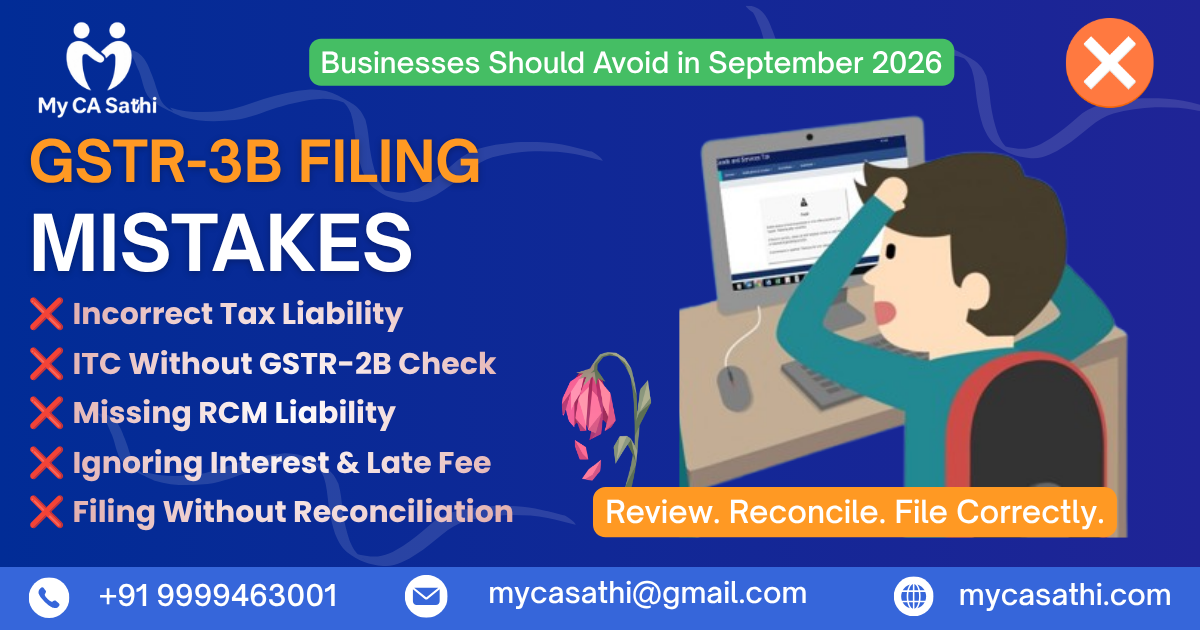
Filing GSTR-3B is an important part of monthly GST compliance for regular taxpayers. While the GST Portal provides auto-populated information from GSTR-1/1A and GSTR-2B, businesses are still responsible for checking the accuracy of the information before filing.
For September 2026 GST compliance, businesses should carefully review their outward supplies, Input Tax Credit (ITC), reverse charge liability, tax payment and previous-period adjustments.
Here are some common GSTR-3B filing mistakes businesses should avoid.
1. Filing GSTR-3B Without Checking GSTR-1/1A
One common mistake is filing GSTR-3B without reconciling the outward supply figures reported in GSTR-1/1A.
The GST Portal uses information from GSTR-1/1A for auto-population in relevant GSTR-3B tables. However, auto-populated figures are meant to assist taxpayers and should still be verified before filing.
Check:
- Taxable sales
- CGST, SGST/UTGST and IGST
- Exempt and nil-rated supplies
- Credit/debit notes
- Amendments
- Reverse charge liabilities
2. Claiming ITC Without Reconciling GSTR-2B
Another important mistake is claiming Input Tax Credit without properly checking GSTR-2B.
Businesses should compare purchase records with GSTR-2B and identify differences before finalising Table 4 of GSTR-3B.
The GST Portal currently auto-populates eligible ITC information from GSTR-2B, but the taxpayer remains responsible for ensuring that the figures reported in the return are correct.
Before filing, check:
- ITC appearing in GSTR-2B
- Purchase register
- Invoices available with the business
- Ineligible ITC
- ITC reversals
- Credit notes
- Duplicate ITC entries
3. Ignoring ITC Reversal
Businesses sometimes focus only on available ITC and overlook ITC that needs to be reversed.
Non-reclaimable and reclaimable ITC reversals need to be reported appropriately in GSTR-3B. The GST Portal guidance distinguishes reporting under Table 4(B)(1) and 4(B)(2), depending on the nature of the reversal.
Before filing, review whether any ITC reversal is required because of:
- Ineligible purchases
- Credit notes
- Applicable blocked credits
- Other reversal requirements
- Temporary/reclaimable reversals
4. Missing Reverse Charge Mechanism (RCM) Liability
RCM transactions should not be overlooked while preparing GSTR-3B.
Businesses should review expenses and purchases that may attract reverse charge and ensure the applicable liability is reported correctly.
RCM liability should also be considered while checking the corresponding ITC eligibility.
Common areas to review include:
- Legal/professional services where applicable
- Certain specified services
- Other notified RCM transactions
- Import of services, where applicable
5. Reporting Incorrect Taxable Turnover
Entering an incorrect taxable turnover can result in incorrect GST liability.
Businesses should reconcile their sales register with the GST returns before filing.
Check whether the following have been properly considered:
Sales Register → GSTR-1/1A → GSTR-3B
Any difference should be investigated before the return is filed.
6. Forgetting Exempt, Nil-Rated and Non-GST Supplies
Another mistake is concentrating only on taxable sales and ignoring exempt, nil-rated or non-GST transactions.
These supplies may need to be appropriately reported in GSTR-3B.
Businesses should therefore reconcile their books and sales records before completing the relevant GSTR-3B tables.
7. Filing a Nil GSTR-3B Incorrectly
A business should not assume that zero taxable sales automatically means a Nil GSTR-3B can be filed.
The GST Portal specifies conditions for Nil filing. For example, the return cannot be filed as Nil when applicable auto-populated data, manual entries or outstanding interest/late fee prevents Nil filing.
Therefore, businesses should check the complete GST position before selecting the Nil Return option.
8. Ignoring Previous-Period Interest and Late Fee
If there is outstanding interest or late fee from an earlier return period, businesses should not ignore it while filing the current GSTR-3B.
The GST Portal provides system-generated interest and late-fee information, and taxpayers can review the details in the relevant section.
For delayed tax payments, interest may apply, and the GST Portal provides a facility to recompute system-calculated interest where applicable.
9. Not Checking the System-Generated GSTR-3B
The GST Portal provides a System Generated GSTR-3B containing information based on relevant GST return data.
However, businesses should not simply accept the figures without review.
The GST Portal specifically states that auto-populated values are provided for assistance and taxpayers must ensure the correctness of the values reported in the filed GSTR-3B.
Best practice: Download and review the system-generated GSTR-3B before final submission.
10. Making Manual Changes Without Reconciliation
Auto-populated figures can be edited where required, but businesses should have supporting records for any significant difference.
Before changing an auto-populated figure, compare it with:
- Books of accounts
- Sales register
- Purchase register
- GSTR-1/1A
- GSTR-2B
- Tax invoices
- Credit/debit notes
This helps create a clear reconciliation trail.
11. Forgetting to Save the Return Before Payment
Another practical filing mistake is proceeding towards payment without properly saving the entered GSTR-3B details.
The GST Portal advises taxpayers to save the form before proceeding with payment.
Always review the saved return before moving to the payment and filing stage.
12. Not Checking Tax Payment and ITC Utilisation
After determining the GST liability, businesses should verify whether the available ITC and cash balance are sufficient to discharge the liability.
Certain liabilities, such as applicable reverse charge liabilities, interest and late fee, have specific payment/utilisation rules.
Before filing, check:
- Electronic Credit Ledger
- Electronic Cash Ledger
- Tax liability
- RCM liability
- Interest
- Late fee
- Final amount payable
13. Filing Without Reviewing Credit and Debit Notes
Credit notes and debit notes can affect the taxable value and GST liability.
Businesses should reconcile these documents with their books and GSTR-1/1A before finalising GSTR-3B.
Ignoring adjustments can result in differences between books, GSTR-1 and GSTR-3B.
14. Ignoring Previous Return Errors
A mistake from an earlier tax period can affect the current return.
Before filing September 2026 GSTR-3B, businesses should review previous returns for:
- Incorrect ITC claims
- ITC reversals
- Tax liability differences
- RCM differences
- Interest
- Late fees
- Previous-period liabilities
Where previous-period liability needs to be considered, the GST Portal provides a mechanism for providing the relevant tax-liability breakup for interest computation.
September 2026 GSTR-3B Filing Checklist
Before filing your September 2026 GSTR-3B, review the following:
☑ Reconcile sales with GSTR-1/1A
☑ Verify taxable turnover
☑ Check exempt and nil-rated supplies
☑ Reconcile purchase records with GSTR-2B
☑ Verify eligible ITC
☑ Check ITC reversals
☑ Review RCM transactions
☑ Check credit and debit notes
☑ Review previous-period liabilities
☑ Check interest and late fee
☑ Review the system-generated GSTR-3B
☑ Verify cash and credit ledger balances
☑ Save and preview the return
☑ Confirm payment and file the return
How Businesses Can Avoid GSTR-3B Mistakes
Instead of preparing GSTR-3B at the last minute, businesses should follow a monthly reconciliation process.
Step 1: Reconcile Sales
Compare books with GSTR-1/1A.
Step 2: Reconcile Purchases
Compare the purchase register with GSTR-2B.
Step 3: Review ITC
Identify eligible, ineligible and reversed ITC.
Step 4: Check RCM
Review expenses and transactions that may attract reverse charge.
Step 5: Calculate Liability
Verify GST liability after considering eligible ITC.
Step 6: Review Interest & Late Fee
Check any outstanding amounts from previous periods.
Step 7: Review GSTR-3B
Compare system-generated information with your books and supporting records.
Step 8: File After Final Verification
Save, preview, pay applicable liability and file the return.
Conclusion
GSTR-3B filing involves more than simply entering figures and submitting the return. Businesses should reconcile their sales, purchases, ITC, RCM transactions, previous-period liabilities and tax payments before filing.
For September 2026, a proper reconciliation process can help businesses identify discrepancies before filing and maintain more accurate GST records.
Regular GST reconciliation is especially important when there are differences between books, GSTR-1/1A and GSTR-2B.
Key Takeaways
- GST registration requirements depend on turnover and nature of business.
- Timely filing helps avoid unnecessary interest and late fees.
- Businesses should maintain proper invoices and supporting documents.
Important Note
Tax rules and compliance requirements may change from time to time. Always verify the applicable provisions before taking any action.
